






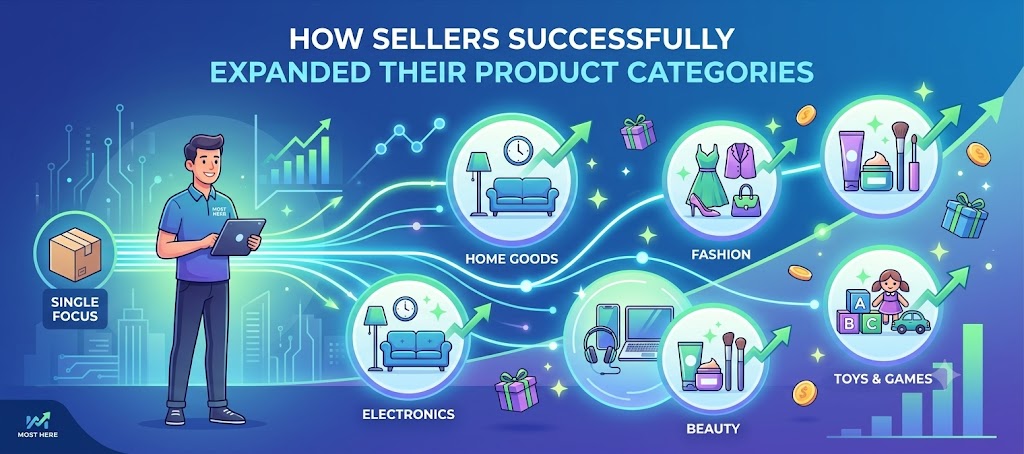
Expanding a product catalog can be an exciting step for any e-commerce seller. More products can create new sales opportunities, attract different customer needs, and increase the value of an existing customer base.
But adding products simply because they are popular is not always a good growth strategy.
Successful sellers usually expand their product categories with a clear reason, customer understanding, and careful planning. They look at what their existing customers need, what products complement their current range, how much inventory they can manage, and whether a new category can support healthy margins.
For sellers in the UAE, this approach can be especially useful because the online market includes customers with diverse preferences and expectations.
Why Sellers Expand Their Product Categories
A seller may begin with one focused product category and gradually discover opportunities to expand.
Common reasons include:
-
Existing customers asking for related products
-
Strong demand for complementary products
-
Opportunities to increase average order value
-
Seasonal demand
-
Changes in customer preferences
-
Opportunities to serve a wider audience
-
Supplier opportunities
-
Strong performance in the original category
For example, a seller specializing in home organization products may discover that customers also need storage accessories, cleaning organizers, or related household products.
The expansion makes sense because the new products are connected to an existing customer need.
Successful Sellers Don't Expand Too Quickly
One of the biggest mistakes sellers can make is adding too many products at once.
A larger catalog means more:
-
Inventory
-
Product descriptions
-
Images
-
Supplier relationships
-
Storage requirements
-
Customer questions
-
Returns
-
Marketing work
-
Financial investment
Successful sellers often expand gradually.
They may test a small number of products, measure the response, and then decide whether the category deserves additional investment.
This creates a simple process:
Research → Test → Measure → Improve → Expand
They Study Existing Customers First
Existing customers can provide valuable clues about what products to add next.
Sellers can study:
-
Frequently purchased products
-
Customer questions
-
Product reviews
-
Search behavior
-
Repeat purchases
-
Frequently requested products
-
Products purchased together
Suppose customers repeatedly ask whether the seller offers a complementary product.
That request could indicate an opportunity.
Instead of entering an unrelated category, the seller can explore a product that naturally fits the customer's existing needs.
They Look for Complementary Products
One of the simplest ways to expand a product category is to introduce products that complement existing products.
For example:
Fitness products → accessories, recovery products, storage solutions
Home office products → organizers, lighting accessories, desk accessories
Beauty products → complementary tools and accessories
Pet products → grooming, feeding, and care accessories
The exact opportunity depends on the seller's market and customer base.
The important principle is that the new product should make sense from the customer's perspective.
They Use Existing Customer Trust
A seller with an established customer base has an advantage when introducing related products.
Customers who already trust the business may be more willing to consider another product from the same seller.
This does not guarantee sales.
The new product still needs to offer genuine value, reasonable pricing, and reliable quality.
However, existing customer relationships can provide a useful starting point for testing a new category.
They Research Demand Before Buying Inventory
Before investing in a new category, sellers can research whether sufficient demand exists.
Useful information can come from:
-
Marketplace search data
-
Customer inquiries
-
Existing sales
-
Product reviews
-
Competitor listings
-
Industry research
-
Search trends
-
Social media discussions
The goal is not to predict demand perfectly.
It is to reduce unnecessary uncertainty before committing significant money to inventory.
They Evaluate Profitability, Not Just Sales Potential
A product can sell well and still be a poor business decision.
Sellers should consider the complete cost structure.
This can include:
-
Product cost
-
Shipping
-
Customs and import-related costs where applicable
-
Packaging
-
Marketplace fees
-
Payment costs
-
Advertising
-
Storage
-
Returns
-
Customer support
After accounting for these costs, the seller can evaluate whether the expected margin makes sense.
This is especially important when entering a category with significant logistics or return costs.
They Test Products Before Scaling
Successful sellers often avoid placing a very large initial order for an untested product.
Instead, they may introduce a limited quantity and monitor:
-
Views
-
Orders
-
Conversion rate
-
Customer feedback
-
Returns
-
Profitability
-
Repeat interest
If the product performs well, the seller can gradually increase inventory.
If the response is weak, the seller can investigate the reasons before committing more resources.
They Consider the Supplier Before Expanding
A new product category can create new supplier requirements.
Before expanding, sellers should evaluate:
-
Product quality
-
Supplier reliability
-
Minimum order quantities
-
Lead times
-
Pricing
-
Production capacity
-
Packaging
-
Communication
-
Quality consistency
A supplier that performs well for a small order may need to demonstrate that it can support larger volumes.
Reliable sourcing becomes increasingly important as the business grows.
They Protect Product Quality
Adding a new category should not reduce the quality standards customers already associate with the business.
Successful sellers establish clear expectations for:
-
Materials
-
Product specifications
-
Packaging
-
Quality control
-
Product testing where appropriate
-
Delivery condition
A poor-quality product can create negative reviews and returns that affect customer trust.
They Study the Competition
Competitor research can help sellers understand the existing market.
They can examine:
-
Product selection
-
Pricing
-
Customer reviews
-
Product presentation
-
Delivery promises
-
Promotions
-
Customer complaints
The objective should not simply be to copy competitors.
Instead, sellers can identify gaps.
For example, customers may repeatedly complain about unclear product descriptions or poor packaging.
That may indicate an opportunity to create a better customer experience.
They Look for Gaps in the Market
Successful category expansion often comes from identifying an unmet customer need.
A gap could involve:
-
Limited product selection
-
Poor product information
-
Lack of certain sizes
-
Weak packaging
-
Limited availability
-
Poor customer service
-
Few options at a particular price point
The opportunity is not necessarily to create a completely new product.
Sometimes it is about offering an existing product in a way that solves a customer problem better.
They Think About the Complete Product Portfolio
Every new product should have a role within the business.
Sellers can ask:
Does this product attract new customers?
Does it complement an existing product?
Can it increase repeat purchases?
Does it improve the overall product range?
Does it offer healthy margins?
Can we source it reliably?
These questions help prevent the catalog from becoming a random collection of products.
They Use Bundles and Cross-Selling
Category expansion can also create opportunities to sell products together.
For example:
Main product + accessory + complementary item
A relevant bundle can make shopping easier for customers and potentially increase average order value.
However, bundles should provide genuine convenience or value rather than simply adding unnecessary products.
They Use Data to Decide What to Expand
Once new products are introduced, sellers should monitor performance.
Useful metrics include:
-
Sales volume
-
Conversion rate
-
Gross margin
-
Return rate
-
Average order value
-
Repeat purchases
-
Customer acquisition cost
-
Inventory turnover
Data can reveal whether a category is actually contributing to the business.
A category may generate strong revenue but have low margins.
Another may have modest sales but strong repeat-purchase potential.
Looking at multiple metrics gives sellers a clearer picture.
They Know When to Remove Products
Successful category management is not only about adding products.
Sometimes products need to be removed.
A seller may reconsider products that consistently have:
-
Low demand
-
Low margins
-
High return rates
-
Poor reviews
-
Difficult sourcing
-
High storage costs
-
Unreliable suppliers
Removing weak products can free up capital and operational capacity for stronger opportunities.
They Prepare Their Operations
Expanding categories affects more than the product catalog.
The business may need to update:
-
Inventory systems
-
Storage
-
Packaging
-
Product photography
-
Website categories
-
Customer support
-
Shipping processes
-
Accounting
-
Marketing
Before launching a new category, sellers should understand whether their current operation can support it.
They Keep the Brand Consistent
A seller can expand into new categories without making the brand confusing.
Customers should still understand:
-
What the business represents
-
Who it serves
-
What type of quality to expect
-
Why the products belong together
For example, a business positioned around practical lifestyle products can potentially expand across several related categories while maintaining a consistent identity.
The expansion should feel intentional rather than random.
They Understand the UAE Customer
The UAE has a diverse consumer market, so sellers should research the specific customer groups they want to serve.
Category expansion can be influenced by:
-
Customer preferences
-
Price sensitivity
-
Seasonal demand
-
Delivery expectations
-
Product availability
-
Competition
-
Purchasing behavior
Businesses should also consider the legal, licensing, consumer protection, product compliance, taxation, import, and privacy requirements applicable to their particular products and operations in the UAE.
A Practical Category Expansion Framework
Sellers can use the following framework before entering a new category:
1. Identify the Opportunity
Look at customer requests, sales patterns, and market gaps.
2. Research the Market
Study demand, competition, pricing, and customer expectations.
3. Evaluate Suppliers
Check quality, pricing, lead times, and reliability.
4. Calculate the Economics
Estimate the complete cost and potential margin.
5. Test Small
Start with a manageable quantity.
6. Measure Performance
Track sales, returns, reviews, and profitability.
7. Improve
Adjust pricing, listings, packaging, or marketing based on results.
8. Scale the Category
Increase inventory and marketing only when the evidence supports expansion.
9. Review Regularly
Keep strong products and reconsider products that consistently underperform.
Common Mistakes to Avoid
Adding Too Many Products
A large catalog can create unnecessary complexity.
Following Every Trend
A trending product may not fit the seller's customers or business model.
Ignoring Profit Margins
High sales do not necessarily mean strong profitability.
Choosing Suppliers Only on Price
Low supplier pricing can become expensive if quality and reliability are poor.
Buying Too Much Inventory
Large initial orders can create cash-flow and storage problems.
Ignoring Customer Feedback
Customers often provide useful information about what is missing from the product range.
Expanding Without Operational Planning
More products require better inventory, fulfillment, and customer-service processes.
Final Thoughts
Successful product-category expansion is rarely about simply adding more products.
It is about understanding customers, identifying relevant opportunities, testing carefully, managing suppliers, protecting quality, and using data to decide where to invest next.
For UAE e-commerce sellers, expanding into related categories can create opportunities to serve existing customers more effectively while reaching new customer segments.
The strongest approach is usually not:
“Let's sell more products.”
It is:
“What additional products can genuinely help our customers, fit our brand, and make business sense?”
When sellers answer that question carefully, category expansion becomes more than catalog growth. It becomes a structured way to strengthen the business, increase customer value, and build a more sustainable e-commerce operation.
Customer Ratings & Review
Robert Fox
Verified purchase
Very nice ! On the other hand, we denounce with righteous indignation and dislike men who are so beguiled and demoralized by the
was this review helpful to you?
Thank (234) Dislike (12)Jenny Wilson
Verified purchase
Very nice ! On the other hand, we denounce with righteous indignation and dislike men who are so beguiled and demoralized by the
was this review helpful to you?
Thank (234) Dislike (12)Brooklyn Simmons
Verified purchase
Very nice ! On the other hand, we denounce with righteous indignation and dislike men who are so beguiled and demoralized by the
was this review helpful to you?
Thank (234) Dislike (12)