






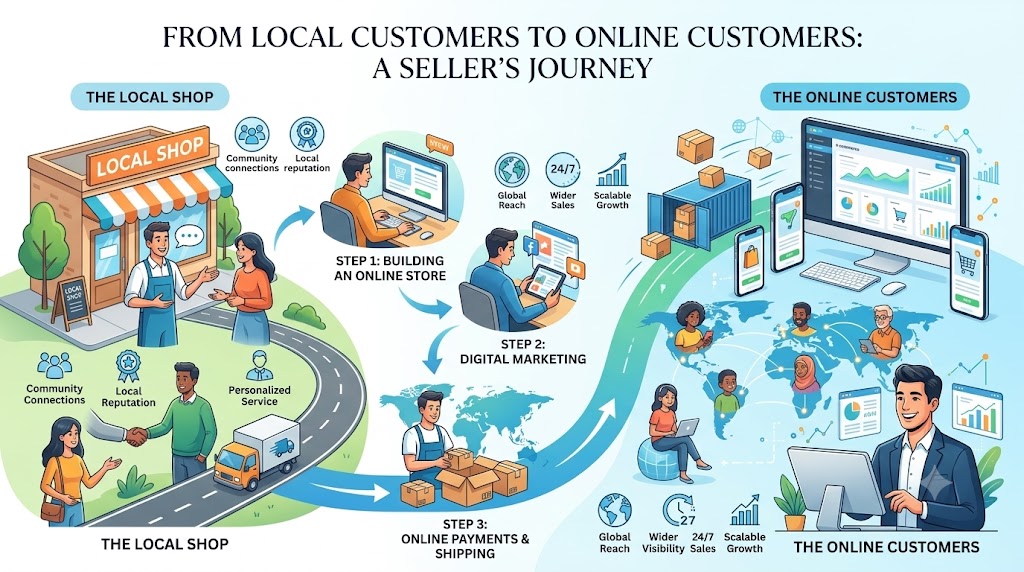
For many small businesses, the first customers are not found online.
They may come from the local community, personal recommendations, nearby shops, family networks or people who have discovered the business through word of mouth.
But as customer expectations change and online shopping becomes part of everyday life, many local sellers start asking an important question:
“How can I take the business I built locally and bring it online?”
The transition from local customers to online customers can open new opportunities, but it also requires a different way of thinking.
A seller who knows customers personally may now need to communicate through product pages, reviews, social media, online marketplaces and digital customer service.
For UAE businesses, this journey can be particularly interesting because a local brand can use digital channels to reach customers beyond its immediate neighbourhood.
The journey is not simply about putting products on a website.
It is about taking the trust, product knowledge and customer understanding developed offline and turning them into a strong online experience.
1. The Journey Usually Starts With Local Trust
Many small businesses grow because local customers trust them.
A customer may have purchased from the seller before, recommended the business to a friend or returned because they were satisfied with the previous experience.
This creates something valuable:
Customer trust.
When moving online, the seller should not forget this foundation.
Instead, the goal should be to bring that same sense of reliability into the digital experience.
The online customer should still feel that there is a real business behind the product.
2. They Start by Understanding Their Existing Customers
Before going online, a seller already has valuable information.
They may know:
-
Which products customers prefer
-
Which products receive the most questions
-
What customers consider good value
-
Which products are purchased repeatedly
-
What customers complain about
-
What makes customers recommend the business
This knowledge can become the starting point for an online strategy.
Instead of uploading every product immediately, the seller can begin with products that already have evidence of customer interest.
3. They Choose the Right Products for Online Selling
Not every product is equally easy to sell online.
Some products require detailed explanations.
Others may depend heavily on physical inspection.
Some may be easy to demonstrate through images and videos.
Before moving online, sellers should consider:
-
Product demand
-
Profit margins
-
Size and weight
-
Packaging requirements
-
Delivery considerations
-
Return possibilities
-
Product complexity
-
Customer expectations
A product that performs well locally may need better presentation or positioning before it succeeds online.
4. They Learn to Present Products Digitally
In a physical store, customers can pick up a product and examine it.
Online, the product listing has to do much of that work.
This means sellers need strong:
-
Product photography
-
Descriptions
-
Specifications
-
Dimensions
-
Usage information
-
FAQs
-
Pricing information
A good online listing answers the questions a customer would normally ask in person.
For example:
Physical store:
“Can I see how big it is?”
Online store:
Show dimensions and a size reference.
Physical store:
“What material is it made from?”
Online store:
Clearly explain the material.
Physical store:
“How do I use it?”
Online store:
Provide simple usage instructions.
The better the information, the less customers need to guess.
5. They Understand That Online Customers Behave Differently
A local customer may already know the seller.
An online customer usually does not.
That means the online shopper may compare:
-
Price
-
Reviews
-
Images
-
Product specifications
-
Delivery options
-
Return policies
-
Customer support
-
Other sellers
The seller therefore needs to communicate value quickly.
A strong online presence should answer an important question:
“Why should a new customer trust this business?”
6. They Build an Online Presence Step by Step
Moving online does not necessarily mean launching everything at once.
A seller can begin with a focused approach:
Step 1: Choose key products
Start with products that have clear demand.
Step 2: Create strong listings
Use accurate images and useful descriptions.
Step 3: Select suitable online channels
Consider a website, marketplace or social-media-based selling depending on the business.
Step 4: Make customer communication easy
Provide clear ways for customers to ask questions.
Step 5: Track results
Monitor sales, customer feedback, returns and other useful business metrics.
Step 6: Improve
Use what customers are telling you to improve the online experience.
7. They Bring Their Local Reputation Online
A local seller may already have years of experience.
The challenge is communicating that experience to someone who has never heard of the business.
This can be done through authentic content such as:
-
Brand story
-
Business history
-
Product knowledge
-
Customer experiences
-
Behind-the-scenes content
-
Educational posts
-
Genuine reviews
The objective is not to make the business appear bigger than it is.
It is to show customers that there is real experience and responsibility behind the brand.
8. They Use Customer Reviews to Build Digital Trust
Reviews can become especially valuable when a seller starts reaching customers outside their local area.
A new customer cannot rely on personal familiarity.
Reviews can provide additional information about:
-
Product quality
-
Customer service
-
Delivery experience
-
Packaging
-
Overall satisfaction
Sellers should focus on earning genuine reviews through good customer experiences.
A strong review profile is not created by simply asking customers to leave five-star ratings.
It is created by consistently giving customers something positive to talk about.
9. They Understand the Importance of Delivery
For local customers, delivery may have been simple.
Perhaps the customer picked up the product or the seller delivered within a small area.
Online growth can change this.
The seller may now need to think about:
-
Packaging
-
Shipping partners
-
Delivery areas
-
Delivery costs
-
Tracking
-
Expected delivery times
-
Damaged shipments
-
Returns
Delivery becomes part of the customer experience.
Even a good product can create dissatisfaction if the fulfilment process is poorly managed.
10. They Improve Packaging as They Grow
Packaging serves more than a practical purpose.
It can also become part of the customer's first physical interaction with an online brand.
Good packaging should protect the product and provide a professional experience.
Depending on the product, sellers can consider:
-
Secure packaging
-
Appropriate box or mailer size
-
Product protection
-
Clear labelling
-
Simple branding
-
Useful instructions
The objective is not necessarily expensive packaging.
It is packaging that is safe, practical and consistent with the brand.
11. They Learn Digital Marketing Gradually
A local seller may have relied heavily on word of mouth.
Online growth introduces new ways to reach customers.
Depending on the business, these can include:
-
Social media
-
Search engines
-
Content marketing
-
Online marketplaces
-
Email communication
-
Paid advertising
-
Customer referrals
But successful online selling is not simply about spending more money on advertisements.
The seller needs to understand:
Which customers are we trying to reach?
What problem are we solving?
Why should they choose us?
Which channel actually brings valuable customers?
This helps make marketing more focused.
12. They Don't Ignore Organic Growth
Paid advertising can help businesses reach potential customers, but useful organic content can also support long-term visibility.
For example, a seller can create content around:
-
Product guides
-
Buying advice
-
Frequently asked questions
-
Product comparisons
-
How-to content
-
Customer problems
-
Industry information
This type of content can help potential customers discover the brand while they are researching a purchase.
It can also demonstrate knowledge and credibility.
13. They Track What Customers Do Online
Moving online provides access to information that may be difficult to see in a traditional local business.
Sellers can analyse things such as:
-
Which products receive attention
-
Which products generate orders
-
Which pages receive interest
-
Which marketing channels generate customers
-
Which products receive returns
-
Which questions customers ask
-
Which products receive repeat purchases
This information can help sellers make more informed decisions.
Instead of asking:
“What do I think customers want?”
they can increasingly ask:
“What is customer behaviour telling us?”
14. They Keep the Human Side of the Business
One risk of moving online is becoming too impersonal.
Customers may be communicating through messages instead of face-to-face conversations.
But the human element still matters.
A seller can maintain it through:
-
Helpful replies
-
Friendly communication
-
Clear explanations
-
Personalised support when appropriate
-
Genuine brand storytelling
Technology can make transactions easier.
But customer relationships still depend on how people are treated.
15. They Use Feedback to Improve the Online Business
The first version of an online store or marketplace presence will rarely be perfect.
Customers may point out:
-
Missing information
-
Confusing navigation
-
Poor images
-
Packaging problems
-
Delivery issues
-
Product questions
-
Payment concerns
Instead of seeing these comments only as complaints, sellers can use them to improve.
For example:
Customers repeatedly ask about dimensions → Add a size guide.
Customers are unsure about product usage → Add instructions.
Customers complain about packaging → Improve protection.
Customers ask about delivery → Make delivery information more visible.
This creates a continuous improvement cycle.
16. They Manage Inventory Differently
A local seller may have been able to manage inventory based on familiar customer demand.
Online selling can change demand patterns.
A product can suddenly attract customers from a wider audience.
This creates new inventory challenges.
Sellers should monitor:
-
Fast-moving products
-
Slow-moving products
-
Reorder levels
-
Supplier lead times
-
Seasonal demand
-
Inventory costs
Running out of a popular product can mean losing sales.
Holding too much slow-moving inventory can tie up business cash.
Balanced inventory planning becomes increasingly important as the online business grows.
17. They Don't Compete Only on Price
When a seller moves online, it can be tempting to reduce prices to compete with other sellers.
But price is not the only factor customers consider.
A business can differentiate itself through:
-
Product quality
-
Better information
-
Reliable service
-
Product expertise
-
Packaging
-
Customer support
-
Convenience
-
Brand experience
A race to the lowest price can make it difficult for a small business to maintain healthy margins.
Instead, sellers should understand what value they can provide beyond price.
18. They Build a Brand Around Their Strengths
The transition from local business to online brand is an opportunity to define what the business represents.
Ask:
What are we known for?
Maybe it is:
-
Product expertise
-
Reliable service
-
A specialised category
-
Quality
-
Convenience
-
Unique products
-
Strong customer support
Once the answer is clear, the online presence can communicate that strength consistently.
19. They Expand Only After the Basics Work
Growth can be exciting.
A seller may want to add:
-
More products
-
More advertising
-
More sales channels
-
More delivery areas
-
More employees
But expansion works better when the basic operation is already under control.
Before scaling, sellers should review:
Product quality
Customer satisfaction
Inventory
Fulfilment
Profit margins
Customer support
Supplier reliability
Strong foundations make growth easier to manage.
20. They Understand That Local Experience Can Become an Online Advantage
A seller who has served local customers for years may already possess something valuable:
Real-world customer knowledge.
They understand questions customers ask.
They know which products people actually use.
They have experience handling complaints.
They understand product quality.
They know what customers value.
The challenge is transforming that knowledge into digital content, product information, customer service and online experiences.
This can become a major strength.
A Simple Roadmap From Local to Online
For sellers considering this transition, the journey can be divided into five stages:
Stage 1: Understand
Study existing customers and identify proven products.
Stage 2: Prepare
Create strong product information, photography, packaging and fulfilment processes.
Stage 3: Launch
Introduce a focused selection through suitable online channels.
Stage 4: Learn
Study sales, reviews, customer questions and operational challenges.
Stage 5: Grow
Expand products, marketing and customer reach based on evidence.
This approach helps turn online expansion into a structured business project rather than an overnight transformation.
Common Mistakes Local Sellers Make When Going Online
The transition can become difficult when sellers:
-
Upload products without proper descriptions
-
Use poor-quality images
-
Ignore online customer questions
-
Depend entirely on discounts
-
Underestimate delivery requirements
-
Keep inaccurate inventory
-
Ignore negative feedback
-
Spend heavily on advertising before testing products
-
Try to sell everything immediately
-
Forget to calculate the full cost of each order
Avoiding these mistakes can help create a more sustainable online operation.
The Bigger Opportunity for UAE Sellers
For a local UAE business, going online can mean reaching customers beyond the immediate area while maintaining the experience that helped the business grow in the first place.
But digital expansion should not mean abandoning the fundamentals of local business.
The same principles still matter:
Know your customers.
Provide good products.
Be reliable.
Communicate clearly.
Solve problems.
Build relationships.
The difference is that online channels allow these principles to reach a much wider audience.
Final Thoughts
The journey from local customers to online customers is not simply a technology upgrade.
It is a transformation in how a seller communicates, markets, fulfils orders and builds relationships.
A business that has already earned local trust has an important foundation. The next step is to translate that experience into a digital environment where new customers can discover the brand, understand its products and feel confident placing an order.
For UAE sellers, the opportunity is not just to sell more products online.
It is to build a stronger, more accessible brand that can serve customers beyond its original local market.
The journey may start with a local customer walking through the door, but with the right strategy, the next customer could be anywhere your online business can reach.
Customer Ratings & Review
Robert Fox
Verified purchase
Very nice ! On the other hand, we denounce with righteous indignation and dislike men who are so beguiled and demoralized by the
was this review helpful to you?
Thank (234) Dislike (12)Jenny Wilson
Verified purchase
Very nice ! On the other hand, we denounce with righteous indignation and dislike men who are so beguiled and demoralized by the
was this review helpful to you?
Thank (234) Dislike (12)Brooklyn Simmons
Verified purchase
Very nice ! On the other hand, we denounce with righteous indignation and dislike men who are so beguiled and demoralized by the
was this review helpful to you?
Thank (234) Dislike (12)