






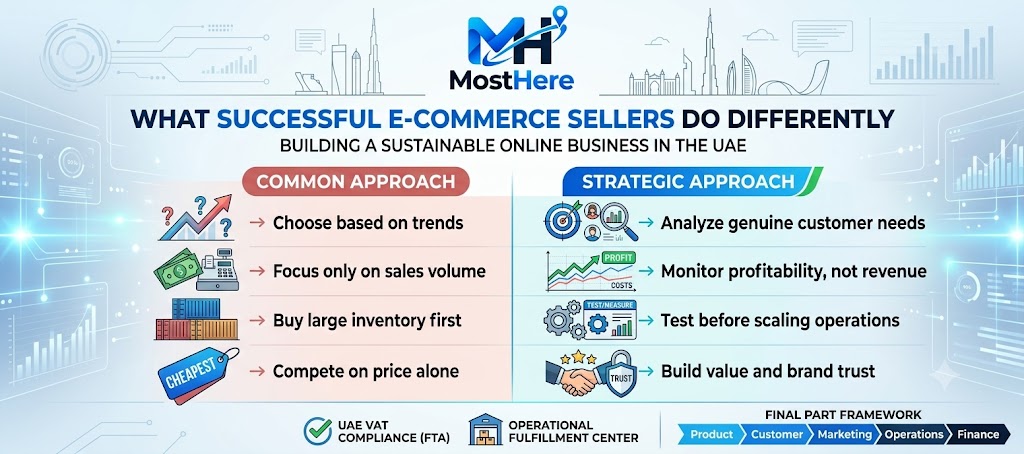
Starting an e-commerce business is easier than ever, but building a business that continues to grow is a different challenge.
Thousands of sellers can list similar products, run advertisements, and compete for the same customers. Yet some sellers gradually build strong businesses while others struggle to generate consistent sales.
The difference is often not simply the product or the size of the marketing budget.
Successful e-commerce sellers approach the business differently.
They understand their customers, monitor their numbers, control costs, improve their operations, build trust, and make decisions based on evidence rather than assumptions.
For entrepreneurs in the UAE, these habits are particularly important because the market is diverse, highly connected, and competitive. A seller needs more than an attractive product listing to build a sustainable online business.
1. Successful Sellers Understand Their Customer First
One of the biggest differences between experienced sellers and beginners is how they think about customers.
A beginner may ask:
“What product should I sell?”
A more strategic seller asks:
“Who am I selling to, and what does this customer actually need?”
This small change in thinking can influence almost every part of the business.
A UAE e-commerce seller should consider:
-
Who is the target customer?
-
What problem are they trying to solve?
-
What price range do they prefer?
-
What influences their purchase decision?
-
What delivery experience do they expect?
-
What alternatives are already available?
-
What would make them choose one seller over another?
When sellers understand their audience, they can create more relevant products, listings, advertisements, and customer experiences.
2. They Do Not Chase Every Trending Product
Trends can create opportunities, but successful sellers do not automatically invest in every product that becomes popular.
They investigate the opportunity first.
Before committing significant money to inventory, they may look at:
-
Existing competition
-
Customer demand
-
Selling prices
-
Product margins
-
Sourcing costs
-
Delivery requirements
-
Return possibilities
-
Product quality
-
Long-term demand
A product can receive a lot of attention and still be difficult to sell profitably.
That is why successful sellers focus on the complete business opportunity rather than simply asking whether a product is trending.
Their approach is often:
Research → Test → Measure → Improve → Scale
Instead of:
Trend → Buy Large Inventory → Advertise → Hope for Sales
3. They Focus on Profit, Not Just Revenue
A business can generate impressive sales numbers without generating healthy profits.
Imagine an online seller generates AED 100,000 in sales.
That sounds impressive, but the seller still needs to consider:
-
Product costs
-
Shipping
-
Packaging
-
Marketplace fees
-
Advertising
-
Payment costs
-
Returns
-
Discounts
-
Storage
-
Staff or operational expenses
-
Taxes where applicable
What remains after these costs provides a much more useful picture of business performance.
Successful sellers therefore monitor profitability alongside revenue.
The Federal Tax Authority provides specific guidance for businesses involved in e-commerce and VAT treatment, and UAE businesses should understand the tax obligations applicable to their particular activities. (FTA UAE)
Revenue tells you how much you sold. Profitability tells you whether the business model is working.
4. They Know Their Numbers
Successful sellers do not rely entirely on intuition.
They regularly monitor business data.
Important metrics can include:
| Metric | Why It Matters |
|---|---|
| Revenue | Measures total sales |
| Gross margin | Shows product-level profitability |
| Conversion rate | Shows how effectively visitors become buyers |
| Average order value | Measures average customer spending |
| Customer acquisition cost | Shows how much it costs to gain a customer |
| Return rate | Identifies potential product or service problems |
| Repeat purchase rate | Indicates customer retention |
| Inventory turnover | Shows how efficiently stock is moving |
| Net profit | Shows overall financial performance |
| Cash flow | Shows available operating cash |
The goal is not to track hundreds of numbers.
It is to identify the numbers that help answer important business questions.
What is selling?
What is profitable?
What is costing too much?
Where are customers dropping off?
Which products deserve more investment?
5. They Test Before They Scale
Successful sellers understand that an idea does not need to be perfect on day one.
They test it.
A seller may test:
-
Different product images
-
Product descriptions
-
Pricing
-
Offers
-
Advertising messages
-
Target audiences
-
Landing pages
-
Packaging
-
Product variations
The results provide information.
If something works, the seller can invest more in it.
If it does not work, the seller can change direction before spending too much money.
This is especially useful for smaller businesses where every investment needs to be carefully managed.
6. They Build Trust Before They Chase Growth
A customer buying online cannot physically inspect the product before placing an order.
Trust therefore becomes an important part of the buying experience.
Successful sellers pay attention to small details such as:
-
Accurate product descriptions
-
Professional images
-
Transparent pricing
-
Clear delivery information
-
Easy communication
-
Reliable fulfilment
-
Clear return policies
-
Genuine customer reviews
-
Secure payment processes
-
Professional packaging
A seller may spend thousands on advertising, but if customers receive poor service, growth can become difficult to sustain.
The UAE's consumer-protection framework includes responsibilities relating to areas such as accurate information, consumer protection, privacy and invoices for applicable e-commerce businesses. Sellers should understand the requirements relevant to their specific activity. (FTA UAE)
Trust is not a marketing campaign. It is built through repeated customer experiences.
7. They Treat Customer Questions as Market Research
Customer service is not only about answering complaints.
It can also reveal what customers actually want to know.
Suppose customers repeatedly ask:
-
“Is this available in another size?”
-
“How long will delivery take?”
-
“Does this product come with a warranty?”
-
“Is this compatible with my device?”
-
“Can I return it?”
-
“What material is it made from?”
These questions reveal gaps in the customer's buying journey.
Successful sellers use this information to improve:
-
Product descriptions
-
FAQs
-
Images
-
Videos
-
Product comparisons
-
Customer-service scripts
-
Website content
A repeated customer question can become an opportunity to improve the entire sales process.
8. They Learn From Negative Reviews
No business receives perfect feedback forever.
A customer may complain about packaging, delivery, product quality, sizing, or expectations.
Successful sellers look beyond the individual complaint.
They ask:
“Is this a one-time issue, or is there a pattern?”
For example:
Repeated packaging complaints
Improve the packaging.
Customers misunderstand the product
Improve the product description.
High return rates
Investigate product quality, sizing, expectations, or listing accuracy.
Delivery complaints
Review fulfilment and logistics.
Instead of hiding from negative feedback, successful sellers use it as information for improvement.
9. They Protect Their Cash Flow
Sales growth can create financial pressure if the business is not managing cash carefully.
A seller might have strong sales but still struggle to pay suppliers because too much money is tied up in inventory.
Successful sellers therefore monitor:
-
Available cash
-
Inventory investment
-
Supplier payments
-
Advertising expenses
-
Refunds
-
Returns
-
Upcoming expenses
-
Expected revenue
This becomes particularly important when the business starts growing quickly.
More orders may require more inventory.
More inventory requires more capital.
Therefore, growth itself needs to be financially managed.
10. They Choose Suppliers for Reliability, Not Just Price
A cheap supplier may look attractive initially.
But if product quality changes, delivery becomes unpredictable, or communication is poor, the seller can end up paying much more through refunds, returns, complaints, and lost customers.
Successful sellers evaluate suppliers based on factors such as:
-
Product quality
-
Consistency
-
Lead times
-
Communication
-
Minimum order quantities
-
Packaging
-
Replacement policies
-
Payment terms
-
Ability to scale
A reliable supplier can become an important part of an e-commerce business's long-term growth.
11. They Think About Fulfilment From Day One
Getting an order is only half of the customer journey.
The next question is:
Can the business deliver the order properly?
Successful sellers think about:
-
Order confirmation
-
Inventory availability
-
Picking and packing
-
Shipping
-
Delivery updates
-
Customer support
-
Returns
-
Refunds
A process that works for 20 orders may not work for 500 orders.
This is why sellers who want to grow need to improve their operational systems alongside their marketing.
12. They Do Not Depend on One Sales Channel
A business that receives almost all of its customers from one marketplace or advertising platform can face additional risk if that channel changes its policies, fees, algorithm, advertising costs, or account requirements.
Successful sellers gradually build multiple customer touchpoints.
Depending on the business, these could include:
-
Marketplace platforms
-
E-commerce websites
-
Search engines
-
Social media
-
Email marketing
-
WhatsApp communication
-
Content marketing
-
Referral programmes
-
Repeat-customer campaigns
The goal is not to be everywhere immediately.
The goal is to gradually create a more diversified customer acquisition system.
13. They Build a Brand, Not Just a Store
A store sells products.
A brand creates recognition.
This distinction becomes increasingly important when several businesses sell similar products.
Successful sellers work on consistency across:
-
Logo
-
Packaging
-
Product photography
-
Website
-
Social media
-
Product descriptions
-
Customer service
-
Communication style
-
After-sales experience
Over time, customers should begin to recognize what makes the business different.
That difference might be:
-
Better quality
-
Better service
-
Unique products
-
Faster fulfilment
-
Better product information
-
Specialized expertise
-
Stronger presentation
A brand does not need to start as a large company.
It can develop one customer interaction at a time.
14. They Reinvest Based on Evidence
When a product performs well, successful sellers do not automatically spend money everywhere.
They ask where additional investment is most likely to create value.
For example, additional funds might be used for:
-
More inventory
-
Better product photography
-
Advertising
-
Packaging
-
Customer service
-
Technology
-
New product variations
-
Content creation
The decision should be connected to actual business performance.
If a product is selling consistently and producing healthy margins, increasing inventory may make sense.
If advertising generates traffic but very few purchases, improving the product page may be more important than increasing the advertising budget.
15. They Know When to Stop Selling a Product
Successful e-commerce sellers understand that not every product deserves unlimited investment.
A product may consistently show:
-
Low demand
-
Poor margins
-
High return rates
-
High advertising costs
-
Frequent complaints
-
Unreliable supply
-
Difficult delivery requirements
Instead of continuing because they have already invested money in it, experienced sellers evaluate the evidence.
Sometimes growth comes from adding a successful product.
Sometimes growth comes from removing the wrong product.
16. They Use Technology to Reduce Unnecessary Work
As an e-commerce business grows, repetitive manual tasks can consume a significant amount of time.
Technology can help with:
-
Inventory management
-
Order processing
-
Customer communication
-
Analytics
-
Marketing
-
Accounting
-
Customer relationship management
-
Reporting
However, successful sellers do not adopt technology simply because it is available.
They ask:
“What business problem will this tool solve?”
The right technology should make the business easier to manage, not unnecessarily complicated.
17. They Take UAE Compliance Seriously
A professional e-commerce business needs to understand the rules that apply to its particular activity.
This can include areas such as:
-
Business licensing
-
Consumer protection
-
Tax and VAT
-
Product requirements
-
Advertising
-
Customer data
-
Invoicing
-
Record keeping
The UAE's Federal Tax Authority currently states that resident businesses generally must register for VAT when taxable supplies and imports exceed AED 375,000 over the previous 12 months or are expected to exceed that threshold within the next 30 days; voluntary registration is available above AED 187,500 under the stated conditions. Specific circumstances can differ, so sellers should verify their own position with the FTA or a qualified professional. (FTA UAE)
For e-commerce businesses, the FTA also has specific guidance and reporting rules concerning qualifying electronic-commerce supplies. (FTA UAE)
Compliance should therefore be treated as part of building a professional business rather than something to consider only after the business becomes large.
18. They Prepare for Seasonal Demand
The UAE e-commerce market can experience changes in purchasing behaviour during important periods such as:
-
Ramadan
-
Eid
-
UAE National Day
-
Back-to-school season
-
Summer periods
-
End-of-year shopping
-
Major promotional campaigns
Successful sellers plan ahead.
They may review:
-
Expected inventory
-
Supplier lead times
-
Delivery capacity
-
Advertising budgets
-
Promotional offers
-
Customer-support capacity
-
Packaging requirements
The goal is not simply to offer the biggest discount.
The goal is to be prepared when customer demand changes.
19. They Focus on Repeat Customers
Acquiring a new customer can require significant marketing effort.
A satisfied existing customer already knows the business.
Successful sellers therefore think beyond the first order.
They can encourage customer relationships through:
-
Good product quality
-
Reliable delivery
-
Helpful communication
-
Relevant product recommendations
-
Loyalty programmes
-
Post-purchase support
-
Useful content
-
Appropriate follow-up communication
The objective is not to send customers unnecessary promotions.
It is to provide a reason for them to consider the business again when they have another relevant need.
20. They Keep Learning
Perhaps the biggest difference is the mindset.
Successful e-commerce sellers understand that the market keeps changing.
Customers change.
Competitors change.
Technology changes.
Advertising platforms change.
Product trends change.
Consumer expectations change.
Instead of assuming that one successful strategy will work forever, successful sellers keep testing and learning.
Their process often looks like:
Observe → Analyse → Test → Learn → Improve → Repeat
This mindset can be more valuable than any single marketing tactic.
What Successful Sellers Do Differently: A Simple Comparison
| Common Approach | More Strategic Approach |
|---|---|
| Choose products based on trends | Research customer demand |
| Focus only on sales | Track profitability |
| Buy large inventory immediately | Test before scaling |
| Compete only on price | Build value and differentiation |
| Ignore negative feedback | Use feedback to improve |
| Depend on one sales channel | Build multiple customer touchpoints |
| Focus only on acquiring customers | Build customer retention |
| Spend heavily on advertising | Measure advertising performance |
| Treat operations as an afterthought | Build fulfilment systems |
| Avoid difficult products | Analyse whether they are worth continuing |
| Use technology because it is popular | Use technology to solve specific problems |
| Think short term | Build for sustainable growth |
A Practical Framework for UAE E-commerce Sellers
A seller looking to build a stronger online business can use a simple five-part framework:
1. Product
Choose products based on genuine customer needs and realistic margins.
2. Customer
Understand who is buying, why they buy, and what they expect.
3. Marketing
Use measurable marketing activities to attract relevant customers.
4. Operations
Build reliable systems for inventory, fulfilment, delivery, returns, and customer service.
5. Finance
Track revenue, costs, profitability, cash flow, and applicable tax obligations.
When these five areas improve together, the business can become more resilient.
Final Thoughts
Successful e-commerce sellers do not necessarily have the biggest budgets, the largest catalogues, or the most advertisements.
What they often do differently is how they make decisions.
They research before investing.
They test before scaling.
They track numbers instead of relying entirely on assumptions.
They listen to customers.
They control costs.
They build trust.
They improve operations.
They understand their responsibilities.
And most importantly, they keep learning.
For entrepreneurs in the UAE, building a successful e-commerce business is not simply about getting more people to click “Buy Now.” It is about creating a business that can consistently deliver value to customers while remaining financially and operationally sustainable.
The strongest foundation is simple:
Understand the customer → Choose carefully → Test → Measure → Improve → Build trust → Scale responsibly.
That is what can turn an online store from a collection of product listings into a real, sustainable e-commerce business.
Customer Ratings & Review
Robert Fox
Verified purchase
Very nice ! On the other hand, we denounce with righteous indignation and dislike men who are so beguiled and demoralized by the
was this review helpful to you?
Thank (234) Dislike (12)Jenny Wilson
Verified purchase
Very nice ! On the other hand, we denounce with righteous indignation and dislike men who are so beguiled and demoralized by the
was this review helpful to you?
Thank (234) Dislike (12)Brooklyn Simmons
Verified purchase
Very nice ! On the other hand, we denounce with righteous indignation and dislike men who are so beguiled and demoralized by the
was this review helpful to you?
Thank (234) Dislike (12)